

I loved programming as a kid because I wanted to make things and I wasn’t particularly handy with wood or metal. A computer gave me a fighting chance. I could have an idea in the morning and, if things went well, play with it that afternoon.
Of course, things often went poorly. The computer insisted we converse in its native language and had strong feelings about punctuation. I liked figuring out how things worked. I’d happily have skipped the hours I spent figuring out which missing bracket had ruined my day.
This year I worked with AI to make a video game in which our two Australian shepherds, Wizzy and Sequel, steal snacks. The idea of playing a game about my own dogs committing petty crimes in our living room made me laugh. I could tell Codex what I wanted in English, play a round, and decide what would make the next round more fun. As a kid, that was the part I was always in a hurry to get to.
I’ve built a handful of iPhone apps the same way over the past year. My favorite is Panda Sit. When a meditation teacher says to sit with a question for a while, I’d like a vote on how long “a while” is. So I made a player that can pause at the end of a chapter and wait for me. I’ve always had little opinions like that about the software I use. Now a bunch of them live on my phone.
Most jobs have their own missing bracket. When I was CRO at Weights & Biases, a rep on my team would learn something important from a customer, enter it in the CRM, summarize it for their manager, then put it on a slide for an account review. I was one of the people who wanted that slide. By the time it got to me, the rep had written down the same thing three times. Getting a customer to tell you what’s really going on takes skill. By the third retelling, we’d put a good salesperson on a well-paid, desk-bound assembly line. I suspect most people who do “knowledge work” can tell you where theirs starts.
I’d measure AI’s success by how much of today’s work it can do well enough that a human gets to put it down. Then I’d ask who gets the time. If AI saves a nurse two hours of charting, does she get to sit a little longer with a frightened patient? Get home for dinner? Or does the hospital give her more patients? I invest in AI companies. It’s easy for me to be excited about those two hours. The nurse has every reason to care what happens to them.
I recognize that I’ve been the hospital in that story. If AI had written those CRM notes for my reps, I’d like to think I’d have sent them back to their customers. I’d also have had a number to hit.
The weekend strikes me as a pretty good piece of human ingenuity. In 1926, Henry Ford gave his factory workers Saturdays off without cutting their weekly pay. Part of his pitch was that people with more leisure buy more clothes, more food, and more cars. It still took a federal law in 1938 to make the 40-hour week the norm. A more productive economy gave us a Saturday at home, but someone had to see the market in it and a lot of people had to push for the law.
I don’t know what bargains we’ll strike around AI, or how we’ll look after each other along the way. It’s hard to ask for a shorter week when you’re worried about keeping your job. Even so, I’m as optimistic about our ability to work that out together as I am about what the technology can do.
What I’m not worried about is humans running out of things to do. Imagine my great-grandfather shadowing me for a week at B Capital. He’d see me light up as a founder described a future that exists only in her head and how she plans to get us there. At the next meeting, he’d hear me tell prospective investors in our fund the story of how I started companies, began investing in them, and wound up running sales at one I’d invested in. Then he’d sit in with my partners as we debated which of two fast-growing companies to back. Whose customers are likelier to stick around? What does one founder see that the rest of us are missing?
From his seat, I’d spent the week playing make-believe with my friends. I’d even treated him to a soliloquy about my career. I can imagine him pulling me aside on Friday. “I’ve had a lovely time, but you really didn’t need to take the week off for me.”
My son is still a toddler. Maybe he’ll grow up to organize dance contests in some VR universe and spend his earnings on virtual spacecraft improvements. I can already hear myself asking whether people pay real money for that. I hope he invites me to shadow him for a week.
I fully expect AI to be a better investor than I am someday. I suspect it’ll still hit me pretty hard the day I’m deciding whether to back a founder and realize I trust its judgment more than my own.
If a machine can do the thing I spent twenty years getting good at, who am I now?
My career has given me a livelihood, a community, and a sense of purpose. I’m incredibly grateful. It’s also a lot to ask of whoever happens to be hiring. People haven’t always expected a job to provide all three. Across generations, family, faith, and the life of a neighborhood have given people a place to belong and a sense of what matters. Someday I’ll ask my son, “What do you want to do with your life?” I hope he hears a much bigger question than “What job do you want?”
Meditation has made me a little suspicious of the premium we put on intelligence. If I sit quietly for a minute, a thought shows up. I didn’t choose it, and half the time I’d have ordered a different one. A sound shows up much the same way, as does a feeling of affection for somebody I love. All of that is part of being alive. How did the part that can solve a problem on a whiteboard get such an outsized vote in what a person is worth?
I’d be delighted to see machines surpass us at a great many things we get paid to do. There are children to raise, elders to look after, neighbors we barely know, stories to tell, new frontiers to explore, and things we’d make just to see if we could. People already give their lives to those things. A few more hours to spend on them would be a fine use of all this intelligence.
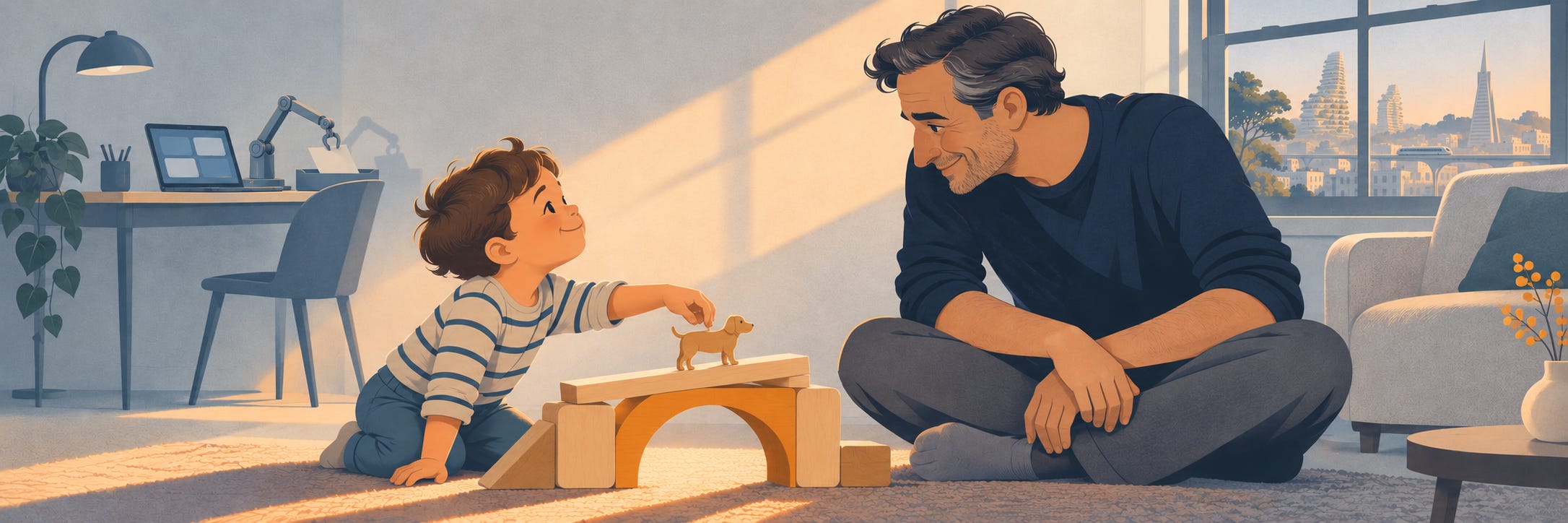
I hope my son gets to build things I can barely understand, with tools that would have thrilled me as a kid. And when he wants to show me what he’s made, I’d like to have the afternoon free.
Low key I keep coming back to the nurse example because it makes it so clear, does she get to actually sit with someone longer or does she just get more patients and more charting. I think about this with my own team a lot, like we save hours with agents now and then I catch myself just filling it back up with more stuff and more stuff and more stuff, and I'm not even sure that's the right move. and the part about your son building things you barely understand yet, that one got me