

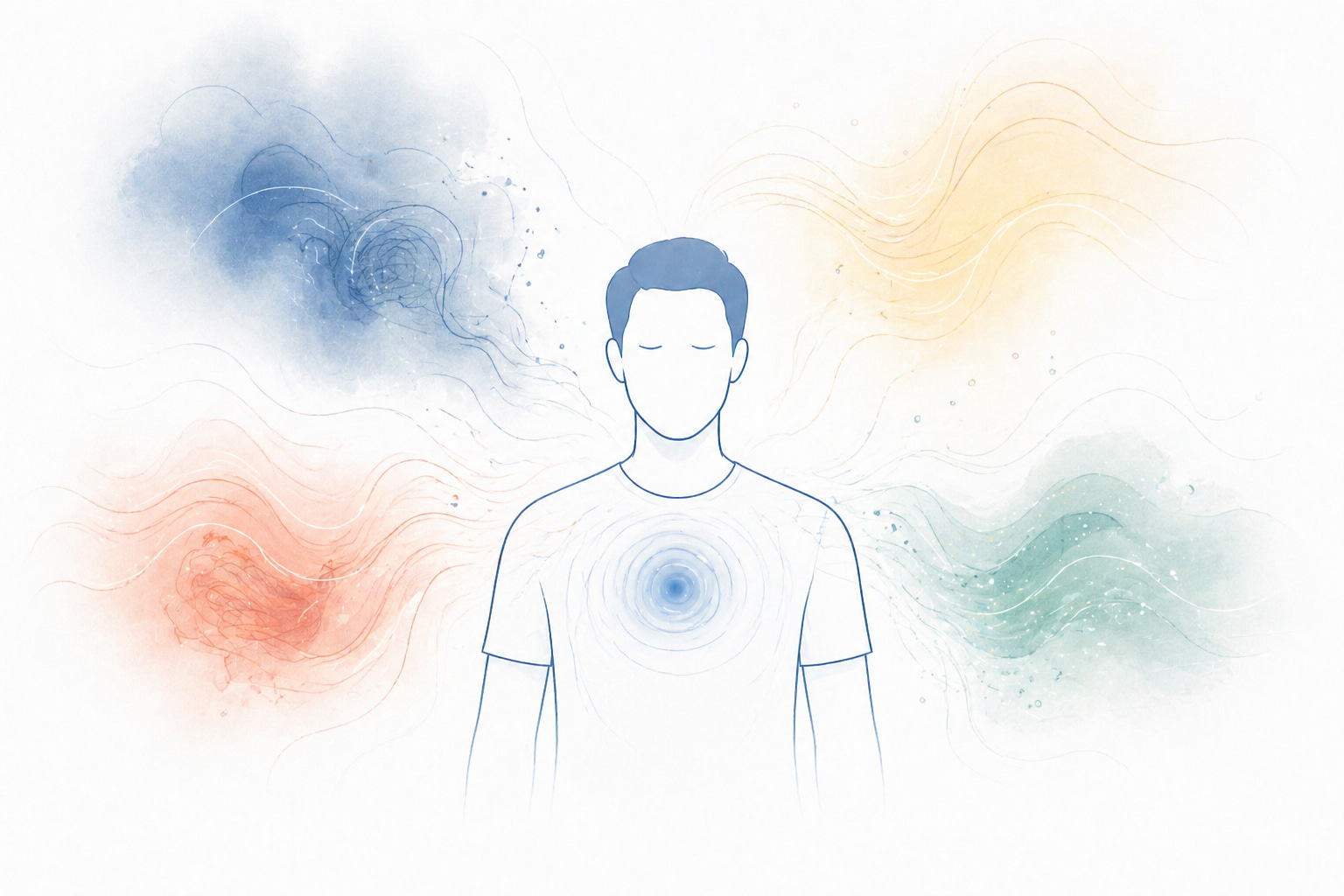
For most of my life, I have been good at thinking about experience.
Too good.
I can analyze the pattern, build the model, identify the incentive, reconstruct the childhood origin, name the attachment dynamic, notice the selfing, reference the fetter, and come up with three plausible interventions before I have actually felt anything.
That can look like insight. Sometimes it is insight.
But a lot of the time it is avoidance with a high IQ.
The instruction that has helped me most is much dumber and much more direct:
Feel the sensation.
Not the story. Not the interpretation. Not the courtroom argument. Not the spiritual analysis. The actual sensation.
The pressure in the chest. The heat in the face. The clamp in the throat. The buzzing behind the eyes. The hollow feeling in the belly. The subtle forward-leaning urgency that wants to send the text, win the argument, close the tab, buy the thing, get reassurance, or disappear.
That is where the work is.
“Feel your feelings” is too vague
People say “feel your feelings” like it is obvious what that means.
It has not been obvious to me.
Is the feeling the sentence in my head? The case for why I am right? The memory? The mood? The identity? The demand that someone understand me? The part that wants to be seen as good? The part that wants to be left alone?
For me, the useful move has been to get much more primitive.
A feeling is not just a thought with emotional punctuation.
It has a body:
Anger is not only “that was unfair.” It is heat, pressure, tightening, forward motion.
Shame is not only “I messed up.” It is collapse, hiding, heat, contraction.
Fear is not only “something bad might happen.” It is buzzing, bracing, shallow breath, a narrowing of the world.
Love is not only “I care about you.” It is warmth, softness, expansion, ache, tenderness.
When I say “feel the sensation,” I mean: stop arguing with the concept and touch the raw data.
My default pattern is to leave the body
I am a founder/investor/operator type. My training is to solve, decide, optimize, explain, and move.
That is useful in companies. It is less useful in the nervous system.
The nervous system does not care how good the memo is.
If something hooks me — a hard conversation, a perceived slight, a conflict with someone I love, a founder in trouble, a deal dynamic, a fear about whether I am being a good husband or father — my mind immediately wants to model it.
What is really going on here?
What should I do?
What is the right frame?
What is the cleanest explanation?
Who is responsible?
What is the next move?
Sometimes those are the right questions. But if I ask them before feeling the body, the answers are usually distorted by the unfelt charge underneath.
The thought may be sophisticated, but the engine is still a contracted chest and a tight jaw.
That is humbling.
Therapy taught me that the story has a body
Therapy has helped me see that my most convincing stories are embodied.
A belief does not feel true because the sentence is well-formed. It feels true because there is somatic force behind it.
“I am behind.”
“I am failing.”
“She is upset with me.”
“They do not respect me.”
“I need to fix this now.”
“I am only safe if I stay in control.”
These thoughts do not arrive as neutral propositions. They arrive with posture, breath, muscle tone, and impulse.
That is why arguing with thoughts often does not work. You can win the debate and still be run by the body.
I can tell myself, “This is irrational,” and still feel the panic.
I can tell myself, “This is just old conditioning,” and still feel the shame.
I can tell myself, “There is no self,” and still be annoyed that someone did not appreciate me.
The leverage is usually not in the argument. The leverage is in feeling the sensation that makes the argument feel mandatory.
When that sensation is finally allowed, the thought often loses its authority. Not because I defeated it. Because the fuel got felt.
Meditation made this embarrassingly literal
Meditation made the whole thing more precise.
In non-dual practice, you start to see that experience is not made of solid objects. It is made of appearances. Sounds appear. Thoughts appear. Images appear. Body sensations appear. Moods appear. Even the feeling of “me” appears.
This is not a philosophy. It is an empirical claim you can test.
Look for the self that is offended.
Where is it?
Usually what I find is a cluster: a thought about what happened, a body contraction, a feeling of being located somewhere behind the eyes, an image or memory, a defensive impulse, a subtle claim of centrality.
The mind staples that cluster together and calls it “me.”
But when I look closely, it is just components.
This is where “feel the sensation” becomes more than emotional hygiene. It becomes insight practice.
The self is not hiding behind the sensations.
The self is partly built out of sensations.
The contraction in the chest is not merely happening to “me.” It is one of the things making “me” feel real.
Feel it clearly enough and the whole construction gets less convincing.
Having a child raised the stakes
Becoming a father has made this less theoretical.
A baby does not care about your self-image as a conscious person.
A baby exposes your nervous system.
Sleep deprivation exposes your nervous system.
Marriage exposes your nervous system.
Dogs barking at the wrong moment, an inbox filling up, a calendar packed too tightly, a deal going sideways, and a baby who needs you right now — all of that exposes what has and has not actually been metabolized.
This has made the practice more honest for me.
It is one thing to have insight on retreat. It is another thing to feel the little surge of irritation before it becomes a tone of voice with someone you love.
That microsecond matters.
Can I feel the contraction before I become it?
Can I feel the urgency before I obey it?
Can I feel the defensiveness before I make a case for it?
That is the practice where it counts.
Not floating above life. Being less hijacked inside it.
Jhānas and metta taught me that happiness is trainable
A lot of inner work can become grim.
You sit with pain. You unwind fear. You investigate shame. You notice craving. You feel grief. Necessary, but easy to turn into heroic self-surgery.
The jhānas changed that for me.
They showed me that joy, happiness, contentment, and ease are not merely outcomes. They are trainable capacities.
Not because the company worked.
Not because the deal closed.
Not because the lift went up.
Not because the baby slept.
Not because the inbox got cleared.
Not because someone finally understood me.
Just because attention, body, and heart can be trained.
That was a big deal for me.
I had spent a lot of life assuming happiness was downstream of conditions. Do the right things, get the right outcomes, earn the right state.
Jhāna and metta practice revealed something more direct: the system can learn wholesome pleasure from the inside.
This matters because feeling sensations is not only about metabolizing pain. It is also about becoming intimate with pleasant experience without clinging to it.
Joy has sensations too.
Love has sensations.
Ease has sensations.
Metta has sensations.
A lot of us are under-trained in receiving the good. The system braces even against happiness. It waits for the other shoe to drop. It turns joy into grasping, performance, or fear of loss.
So the practice is symmetrical:
Feel the grief without drowning in it.
Feel the joy without grabbing it.
Feel the fear without obeying it.
Feel the love without making a self out of it.
Fetters practice: do not believe the glue
Fetters work made this more exacting.
The fetters are not just Buddhist doctrine to me. They are a practical way of finding the mechanisms that create bondage: identity, doubt, ritualized control, desire, aversion, conceit, restlessness, and the rest.
What has surprised me is how physical they are.
A fetter is held together by glue.
The glue is usually sensation plus image plus thought plus avoidance.
Take identity. “I am the kind of person who…” sounds like a sentence, but it is not just a sentence. There is usually a felt sense of being someone. A posture. A location. A shape. A stance toward the world.
Take craving. It is not just “I want that.” It is a forward pull in the body, an image of completion, a little promise that this thing will finally settle something.
Take aversion. It is not just “I do not want this.” It is a push, a hardening, a refusal, a tiny no at the center of experience.
If I only analyze these patterns, they remain mostly intact. The analysis becomes part of the structure.
But if I feel them as sensations, they start to decompose.
What is craving without the forward lean?
What is shame without the heat and collapse?
What is defensiveness without the tightening in the chest and face?
What is “me” without the felt contraction that seems to place me at the center?
This is not a trick question.
It is a practice.
A simple protocol
Here is the version I actually use.
When something hooks me, I try not to start with the content. I start with the body.
Name the hook lightly. “I am hooked.” “Something feels threatened.” “There is shame here.” Keep it simple.
Stop rehearsing the case. For ten seconds, stop proving why you are right. The story will still be available later. It always is.
Locate the sensation. Chest, throat, belly, face, hands, back, eyes. Where is the charge most obvious?
Describe it plainly. Tight, hot, cold, buzzing, heavy, sharp, diffuse, moving, pulsing, numb, hollow, compressed.
Include the resistance. If I hate the sensation, I feel the hate as sensation. If I want it gone, I feel the wanting-it-gone. If I am afraid it will overwhelm me, I feel the fear around the fear.
Let it change or not change. The point is not to make it dissolve. Trying to make it dissolve is often just aversion in a meditation costume.
Check the thought again. After feeling the body directly, I ask: does the thought still have the same authority? Sometimes yes. Often no. Almost always, it is less total.
This can take thirty seconds. It can take an hour. Sometimes it needs therapy. Sometimes it needs a hard conversation. Sometimes it needs sleep, food, exercise, or basic adult problem-solving.
But the order matters.
Feel first. Think second.
This is not bypassing
There is a bad version of this practice.
The bad version says: “It is all just sensation, so nothing matters.”
That is bullshit.
If someone hurts you, you may need boundaries. If you are in a bad situation, you may need to leave. If you are dysregulated, you may need support. If trauma is involved, you may need to go slowly and work with someone who knows what they are doing.
“Feel the sensation” does not mean “ignore reality.”
It means reality includes the body.
It means do not outsource your sense of truth entirely to the story-making mind.
It means do not use concepts to avoid the primitive facts of experience.
It means that before you decide what must be done, you become honest about what is already here.
The thing underneath the thing
The strangest part is that the sensation is often not the enemy.
The fear of the sensation is worse than the sensation.
The resistance to shame is worse than shame.
The panic about grief is worse than grief.
The refusal to feel loneliness is worse than loneliness.
When I actually feel the thing, it is often surprisingly workable. Not pleasant. Not always easy. But finite. Textured. Changing. Made of parts.
The monster becomes pressure, heat, vibration, image, thought.
Still intense. But no longer infinite.
This is one of the most liberating discoveries I know: most of what I am running from is not actually unbearable when met as sensation.
It was unbearable when I believed the story that it should not be there.
Ground truth
I do not think the body is always wise.
The body can be conditioned, confused, defended, traumatized, and wrong. “Trust your gut” is not good enough.
But the body is often honest in a way the verbal mind is not.
The verbal mind is a lobbyist. It argues for whatever identity, fear, desire, or strategy has already taken hold.
The body shows the charge.
That is why feeling sensations is so useful. It brings me back to ground truth. Not ultimate truth. Not cosmic truth. Just the local, immediate, undeniable fact of this moment.
There is tightness.
There is heat.
There is sadness.
There is love.
There is wanting.
There is fear.
There is awareness of all of it.
And none of it needs to become a self.
The whole path, in miniature
A lot of my practice now feels like variations on this one instruction.
In therapy: feel the body beneath the story.
In non-dual meditation: notice sensations as appearances in awareness.
In jhāna and metta practice: learn the sensations of joy, love, contentment, and ease.
In fetters inquiry: deconstruct the sensations that make self, craving, and aversion feel real.
In ordinary life: catch the moment before contraction becomes speech, action, or identity.
Different maps. Same territory.
Feel what is here.
Not because it is noble. Not because it is spiritual. Not because it will make you calm or impressive or enlightened.
Because unfelt sensations run your life from underneath.
Felt sensations become experience.
And experience, when fully allowed, is much less imprisoning than the stories we build to avoid it.